Bayesian analysis
Gist
Basically, what is the general workflow for Bayesian analysis?
Where I used it
When I was a postdoctoral scholar at Cornell University. I had to see if there was a phylogenetic signal in malaria species. I used {brms} (see Bayesian software). It was my first time doing anything with Bayesian stats. I remember my friend Spencer who kept telling me to become a Bayesian when we were in graduate school. I was like “No way man!”
But then when I entered big pharma, one of the first papers I was asked to read was the Bayesian guidance by the FDA. So there seems to be a bigger push for using Bayesian statistics. Specifically, historical borrowing seems to be the biggest perk of becoming a Bayesian.
Workflows
For general data analysis
Martin et al. [1] suggested this Bayesian workflow for data analysis.
!Pasted image 20260808163525.png
Directly copied from their book, but I like this list of questions one should ask when they are going to make a Bayesian model.
- (Likelihood) What distribution describes the observed data given X?
- (Covariates) What is the structure of the latent data generating process?
- (Ignorability) Do we need to model the data collection process?
- (Priors) Before seeing any data what is a reasonable set of parameters?
- Can I express my model in a Probabilistic Programming framework?
- Can we estimate the posterior distributions in a reasonable amount of time?
- Does the posterior computation show any deficiencies?
- Does the prior make sense in the context of math?
- Does the prior make sense in the context of the domain?
- Can our inference engine produce a posterior with the chosen prior?
For SIR modeling, specifically
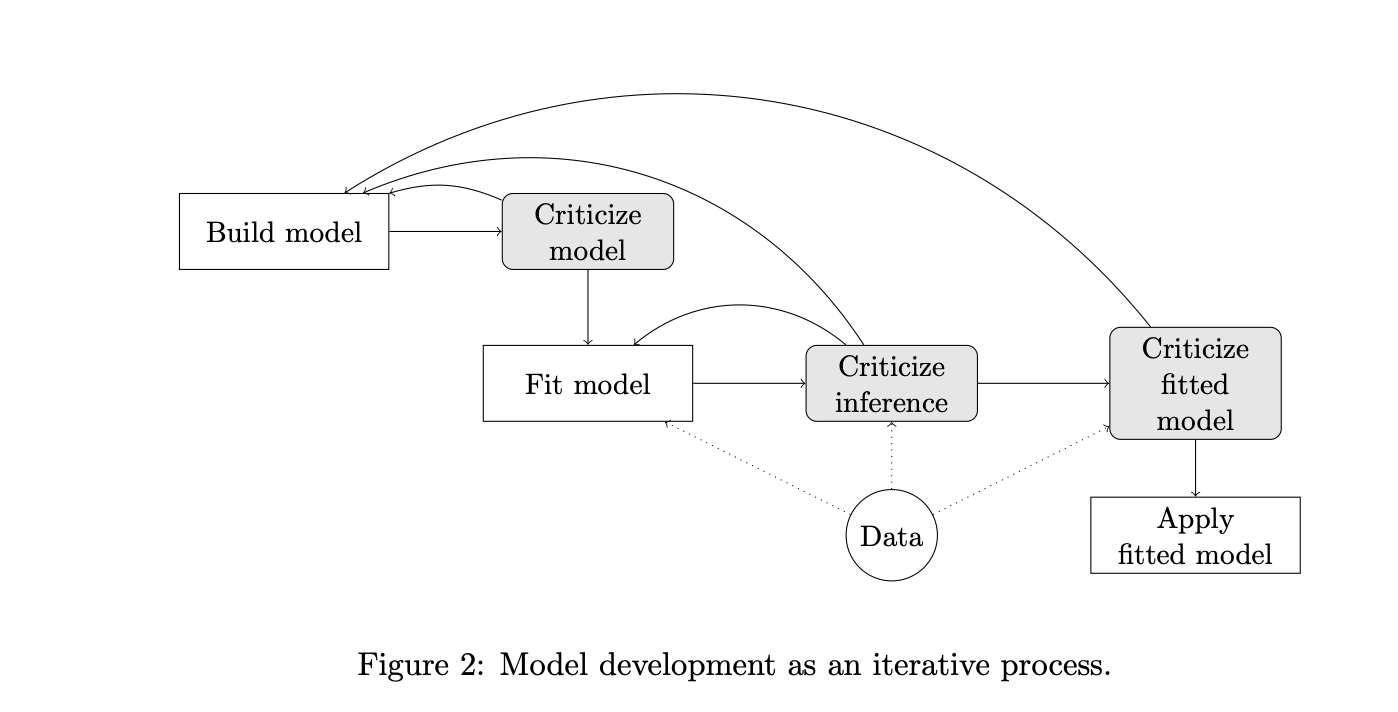
This is the suggested workflow for modeling disease transmission using SIR Model (General) with Stan. But I think this workflow is generalizable to other analyses [2]
-
**Criticize model before looking at data
- Prior predictive check: We want priors that allow for every reasonable configuration of the data but exclude patently absurd scenarios, per our domain expertise.